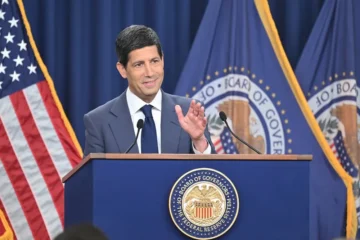
Federal Reserve Governor Waller indicated that the Fed still needs to raise interest rates to curb inflation. Energy prices and AI investments are increasing inflationary pressures, but he left open the possibility of maintaining interest rates in October.
On October 8, 2026, at 3:57 PM, Reuters reported that Christopher Waller, Governor of the Federal Reserve (Fed), stated that the Fed is likely to need to raise interest rates further to control inflation and bring it back to its 2% target. However, he remains flexible regarding the timing of rate hikes, leaving the possibility of keeping interest rates unchanged at its October meeting.
Waller said in a prepared statement for the Turkish central bank meeting in Istanbul that if economic data continues to meet expectations, he believes further interest rate hikes would help inflation return to the 2% target more quickly. However, he added that rate hikes don't necessarily have to happen at every meeting, but should be implemented within an appropriate timeframe.
This view aligns with other Fed officials who have signaled in recent days that the Fed is likely to keep interest rates at 3.75–4.00% at the October 27–28 meeting, before considering another rate hike in December if economic data continues to reflect sustained growth, unemployment remains low, and inflation shows only slight progress in slowing down.
Previously, the Fed raised interest rates by 0.25 percentage points at its September meeting. Estimates released at the time indicated that most Fed officials expected another 0.25 percentage point increase before the end of the year. Meanwhile, investors are assessing that the Fed will keep interest rates unchanged at its October meeting, held about a week before the US congressional elections, and will raise rates at its December 8-9 meeting.
While Waller didn't specify how much further interest rates needed to be raised, he noted that the reasons for tighter monetary policy were becoming clearer: a stronger U.S. economy, the unresolved impact on energy prices from the Iran-Iran conflict, and renewed concerns about investment in artificial intelligence (AI) infrastructure, which is boosting demand for key goods and services and could exacerbate inflationary pressures.
Waller stated that evidence showing economic activity accelerating in the second half of the year means he is not overly concerned that tighter monetary policy will lead to a severe economic slowdown. However, what is worrying is the recent acceleration in inflation, which could cause consumers, investors, and businesses to revise upward their future inflation forecasts.
Waller is the third senior Fed official in recent days to signal that interest rate hikes could be slowed in the short term, even though he still sees the need to increase borrowing costs in the future. Financial markets have already reflected this view in their forecasts for the next interest rate meeting.
This move comes at a time when Federal Reserve Chair Kevin Warsh has yet to comment on the direction of monetary policy. Previously, he stated that he wanted to avoid giving too many premature signals about policy decisions.
However, Waller and other Fed officials continued to communicate their view to the market, explaining that signaling interest rate trends without being tied to predetermined outcomes is a way to help investors better assess the likelihood of monetary policy and reduce potential volatility if the market receives no information about policy direction at all.
Waller emphasized that policymakers can communicate a likely direction while acknowledging that there is no fixed target. This provides markets with a basis for anticipating short-term interest rates, while also allowing the Fed to adjust the pace of rate hikes based on future economic data.
Reference: reuters.com
Read news related to The full US economic situation can be found here.