Economic
-
The Bank of Thailand indicates that Thai inflation is approaching 4% as expected, and projects it to remain high until early 70.
The Bank of Thailand (BOT) forecasts Thailand's inflation rate to remain near 4% per year until the first quarter of 2027 before potentially revising downwards. It is closely monitoring the Middle East conflict, oil prices, and the pass-through of costs to businesses, which could cause inflation to be higher than expected. -
Finance Minister accelerates trade negotiations to help Thai businesses cope with the impact of US politics.
Dr. Ekniti pointed out that US politics is impacting global financial and capital markets, but Thailand is benefiting from AI in the supply chain. He affirmed that continued trade negotiations will help Thai businesses cope with volatility. -
"Supajee" reveals that trade negotiations between Thailand and the United States are progressing, with key points summarized and results expected to be announced in mid-November 2569.
Supajee revealed that negotiations on the reciprocal trade agreement (ART) between Thailand and the United States have reached a conclusion on key issues. The US side proposed announcing the results jointly at the ASEAN Summit in mid-November 2569. -
Dr. Ekniti will propose to the Cabinet next week the criteria for regulating data centers.
Dr. Ekniti is preparing to propose to the Cabinet a set of regulations for data centers, categorized into 7 levels based on electricity usage. This includes the development of a TH-DC dashboard system and stricter environmental and economic standards. -
Yotchanan proposes the "3 Siam" model to cultivate job creators and erase the image of Thailand lagging behind.
Yotchanan points out that the Thai education system is trapped in silos and is outdated. He believes Thailand must stop chasing technology and break down silos to cultivate Thai people into job creators, highlighting the "Siam Silica-Medicar-Flora" strategy. -
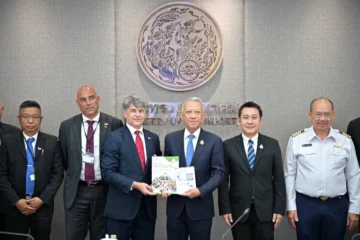
The Ministry of Transport held discussions with six leading US companies to promote Apple Pay, Visa, and a unified ticketing system, thereby upgrading Thailand's transportation system.
Pipat held discussions with the U.S.-ASEAN Business Council and leading companies such as Apple, Boeing, Visa, and 3M, proposing cooperation in four areas: a unified ticketing system, fare payment via Apple Pay, anti-drone technology, increasing direct flights, and enhancing safety. -
Inflation in October surged to 3.90% due to high oil prices and flooding. The Commerce Ministry maintained its full-year inflation target at 2%.
Thailand's inflation rate in October 2569 surged to 3.90%, driven by a 29.18% increase in fuel prices and a more than 56% impact on fresh food prices due to flooding. The Commerce Ministry expects November's inflation to remain positive and maintains its 2569 inflation target at 2%. -
The Excise Department is proposing a 1.2 billion baht scheme to the screening board for "old cars for new cars and electric motorcycles".
The Excise Department has proposed to the loan screening board a 1.2 billion baht budget allocation for projects such as "old car for new pickup truck" and "subsidies for electric motorcycles." Consideration is expected within two weeks. -
The Ministry of Finance unveils a three-tiered EV tax plan with rates ranging from 10-35%, enforced using the "Made in Thailand" criterion.
The Ministry of Finance has unveiled a plan to restructure the EV tax in three tiers, with rates ranging from 10-35%. The tax will be based on the "Made in Thailand" criterion, counting local content in components, and eliminating profit and utility costs from the tax calculation within three years. The aim is to encourage automakers to establish factories in Thailand. -
Google confirms it will continue investing in Thailand, discusses data center projects with Anutin Charnvirakul, and proposes adjustments to water and electricity regulations.
Executives from Alphabet and Google met with the Prime Minister to reaffirm their commitment to investing in Thailand and to discuss adjustments to water and electricity regulations for data centers.